
The cart is usually the last thing anyone thinks about, and it is often the thing sitting lowest to the ground in the most exposed part of the property. By the time the plan is made, it has been left where it always is.
TL;DR
Two facts change how you should think about this. The National Hurricane Center states that storm surge is currently the leading cause of fatalities from hurricanes, and that it can travel up rivers and canals, reaching well inland from the coastline. That means “we are not on the water” is not the protection people assume it is. The second is that Florida’s own emergency management agency organises preparation around knowing your evacuation zone, which is a specific published thing you can look up rather than a general sense of risk. For a cart the practical consequence is that a garage at ground level is storage, not shelter, and the decision about where the car goes should be made at the same time as the decision about where the family goes, not in the last hours before landfall. Move it high, move it inland, or accept that it may be in water.
What Storm Surge Actually Is
The word gets used loosely, and the distinction matters for anyone deciding whether a low-lying garage is safe.
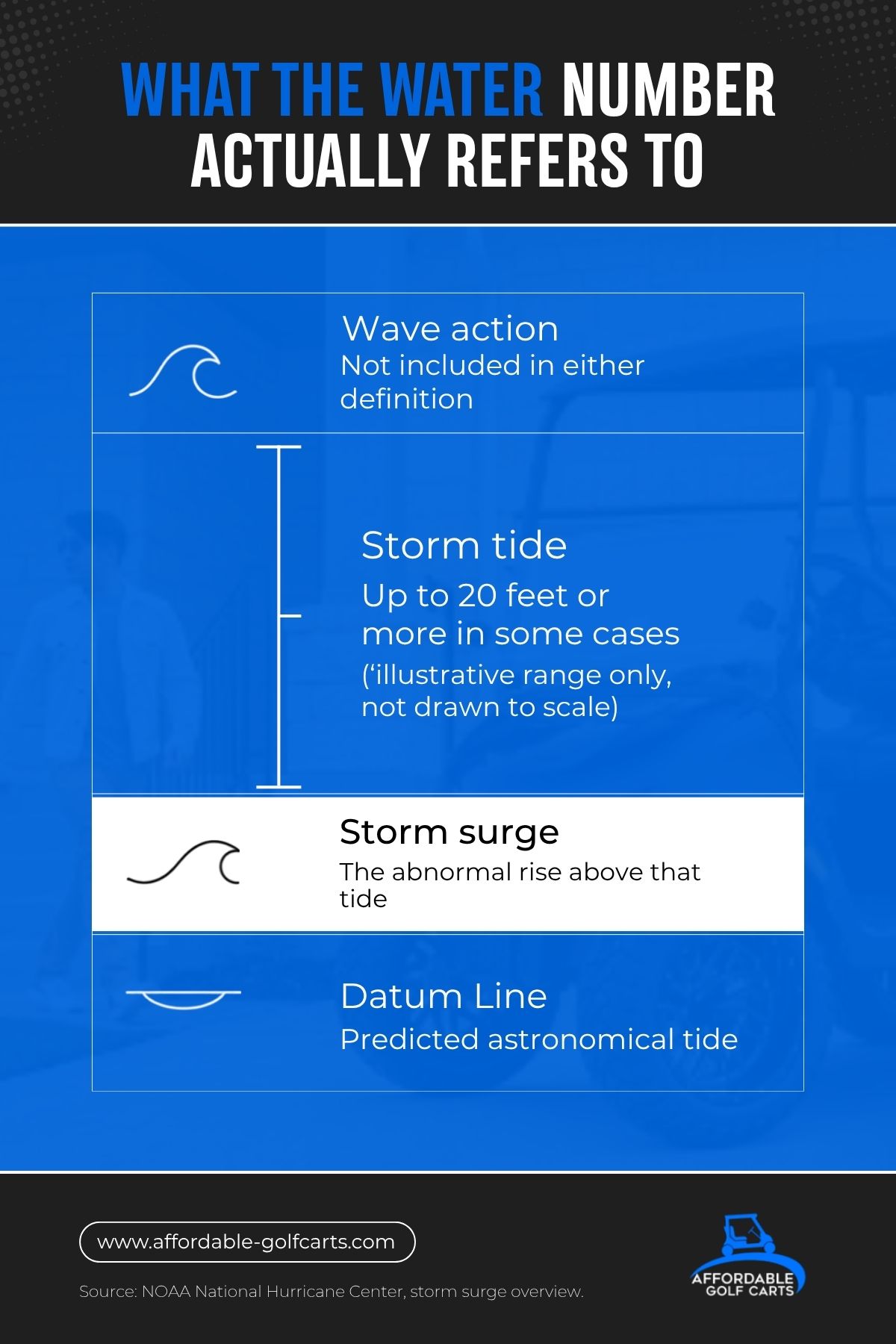
The National Hurricane Center defines storm surge as an abnormal water level rise generated by a storm over and above the predicted astronomical tide. Storm tide is the combination of that surge with the astronomical tide, and the agency notes that this rise can cause extreme flooding in coastal areas, particularly when surge coincides with normal high tide, with storm tides reaching up to 20 feet or more in some cases. It adds that neither definition includes wave action on top of the surge, which can add further feet to the overall water level.
The agency also states plainly that storm surge is currently the leading cause of fatalities from hurricanes, that all locations along the US East and Gulf coasts are vulnerable, and that surge can travel up rivers and canals to reach well inland. The full explanation is on the National Hurricane Center’s storm surge page.
That last point is the one that catches inland owners. A property several miles from open water can still sit on a river or canal system that surge moves up.
Why the mechanism matters for a garage
The Hurricane Center explains how surge forms. Strong onshore winds drive a vertical circulation in the ocean, and while the water is deep, there is nothing to interfere with it. Once the storm reaches shallower water near the coast, the ocean bottom disrupts that circulation; the water can no longer move downward, and it begins to move upward and inland.
Water arriving that way does not respect a garage door. A cart parked at floor level in an attached garage is at the same elevation as the driveway it sits behind.
The agency also notes that the maximum surge for a particular location depends on storm intensity, forward speed, size, angle of approach to the coast, and the shape and characteristics of the coastline. Two storms of the same category do not produce the same water at the same address, which is why the answer is a zone rather than a rule of thumb.
Know the Zone Before You Plan Anything
Florida publishes the thing most people substitute a guess for.
The Florida Division of Emergency Management structures its preparation guidance around knowing your evacuation zone and knowing your home, directing residents to the state’s Know Your Zone map, and noting that this information should drive the decision to evacuate or shelter in place when officials issue orders. It also advises building a disaster supply kit with items to last at least seven days, keeping copies of identification and important documents, and consulting your county emergency management programme for locally relevant information. The guidance is on Florida Disaster’s plan and prepare pages.
Look up your zone once, write it somewhere you will find it, and the cart question answers itself most of the time. A property in an evacuation zone has a cart that needs to leave with everything else. A property outside one has a different, calmer decision to make about elevation and securing.
Do this in June, not in the three days before a named storm. Everything below assumes you already know your zone.
The Cart Decision, in Order
Once you know your zone, the choices narrow quickly.
- If you are in an evacuation zone and leaving, the cart leaves too, or it stays and gets written off in your planning. Towing a cart out is a real option for people with a trailer, and it needs deciding early because the roads change
- If you are staying, get it as high as you reasonably can. Elevation is the only variable you control. A second-floor parking deck, a raised slab, a ramp onto a trailer bed, anything that buys inches
- If it must stay at ground level, move it inland on the property, away from canals, retention ponds, and the low corner where water already collects in ordinary rain
- Secure it against wind separately from water. A cart is light, tall, and has a large canopy area, and the two hazards want different responses
- Photograph it before the storm, with the serial number, for whatever conversation follows.
The order matters because people commonly do step four and skip steps one to three, which protects the cart from being blown over while leaving it exactly where the water will be.
The canopy is the wind problem
A cart’s roof is a sail on a light vehicle. In sustained wind, it is the part that catches, and a cart that gets moved by wind becomes something else’s problem when it hits a wall, a car, or a pool cage.
Removing a canopy is not always practical at short notice. When it isn’t, the cart should be somewhere the wind can’t hit it broadside, which usually means inside something rather than against something.
The Trailer Question People Answer Too Late
Towing a cart out sounds simple until the morning it needs to happen, and there are three things worth establishing while nothing is coming.
The first is whether the cart physically fits. Carts vary in length and width more than people expect, particularly once a rear seat, a cargo box, or a lift kit is on, and a trailer that carried the last one may not carry this one.
The second is whether you can load it. A cart with a flat battery, a seized brake, or a controller fault does not roll onto a trailer easily, and discovering that during an evacuation is the wrong time. If a cart has been sitting, whether it will move at all comes before where it goes.
The third is where it would actually go. Somewhere inland, above the flood risk, with permission to leave it there. A relative’s garage two counties over is a plan. A vague intention to head north is not, and the roads during an evacuation are not the place to be improvising storage.
If towing is not an option
Plenty of owners have no trailer and no tow vehicle, and the honest answer is that elevation on the property becomes the whole strategy.
Look at your own land in ordinary heavy rain and note where water collects and where it does not. That observation, made in an afternoon in July, is worth more than any general advice, because it is specific to your ground. The high corner you identify then is where the cart goes later.
Where the whole property is low, and the zone says evacuate, the realistic position is that the cart is at risk, and the planning should say so. Writing that down in advance is better than believing something that is not true.
What to Do in the Twenty-Four Hours Before
By this point, the decisions are made, and the work is short, which is the whole reason for doing the thinking in July.
Move the cart to wherever the plan said, and do it before the weather arrives rather than during the first squall. Roads and driveways get worse quickly, and a cart being pushed in the wind is a two-person job that becomes a bad idea.
Disconnect and remove what you can. Chargers come off and go somewhere dry and high. Loose accessories, coolers, covers, and anything on the roof come off entirely, because in the wind they either leave or take the cart with them.
Photograph it where it now stands, including the serial number and any existing damage. Two minutes on a phone, stored somewhere that is not only on that phone.
Then leave it alone. There is nothing else productive to do to a cart in the last hours before a storm, and the time is better spent on the parts of the plan that involve people.
After the Water Goes Down
This is the part where an expensive mistake gets made in the first hour, and where we would rather you called us than experimented.
If a cart has been in floodwater, do not turn it on and do not attempt to charge it. Whether the drivetrain is lead-acid or lithium, a system that has been submerged is not a system whose condition you can assess by looking at it, and energising it is the wrong first move. Saltwater makes this worse than fresh water, because salt is conductive and stays behind after the water leaves.
What we can tell you is who should make that call. The battery manufacturer’s own guidance for that specific pack governs what happens next, and every serious manufacturer publishes handling instructions for water exposure. Find the model, find the document, and follow it rather than a general rule from the internet.
What we are not going to do is print a procedure. Battery chemistries differ, packs differ, and a wrong instruction on a page like this could cause a fire in somebody’s garage. Bring it to us, or contact the manufacturer, and let the answer come from the people who built it.
What Insurance Does Not Automatically Do
Worth a paragraph because the assumption is common and the season is the wrong time to find out.
A cart is not automatically covered by the policy that covers the house or the car. Whether flood damage to it is covered by anything you hold is a question for your insurer and only for your insurer, and the answer depends on the specific wording rather than on what is usual.
The useful move is to ask before the season rather than after an event. Photographs, the serial number, and a written answer from whoever writes your cover are worth more than any preparation step on this page, because they determine what happens if the preparation fails.
The Off-Season Version of This Job
Everything above is easier if some of it is already done, and none of it needs a storm in the forecast.
Look up your zone. Work out whether the cart can physically be moved to higher ground on your property, and if it cannot, establish that now rather than in a queue of traffic. Check whether it fits on your trailer. Find where the manufacturer’s documentation lives. Ask the insurance question.
That is an afternoon in the spring, and it converts a frantic decision into a short one. If you are buying, it is also worth thinking about where a cart will live before you own it, which is one of the practical questions in our buying guide, and battery type is part of the same conversation, covered in our comparison of lithium against lead-acid for Florida carts.
For owners weighing repair after any kind of damage, what cart repairs cost sets out the shape of that decision.
Sort the Cart Question Before the Next Named Storm
The zone lookup takes two minutes, and the rest follows from it. If you are unsure whether your cart can be moved, secured, or transported, come and ask us while there is nothing in the forecast. Affordable Golf Carts is in Hudson, and the quiet part of the year is when this conversation is actually useful.
