Financing a golf cart in Florida works a lot like financing a car, just smaller. You pick a cart from the new inventory, put a little money down, and pay the rest in monthly installments over 24 to 72 months through a lender the dealer works with. Approval depends mostly on your credit tier, income, and how much you put down. A budget cart in the low-to-mid thousands can land in a manageable monthly payment for many buyers, though the exact number moves with your rate and term. There are no guaranteed approvals, and anyone promising one is worth a second look. Below is the honest version: real payment math, the credit tiers lenders sort you into, how new and used carts finance differently, and what to bring so a dealer can actually run your application.
What This Guide Walks Through For First-Time Buyers
Most people who call us about payments have never financed anything but a car or a house, so a cart feels like unfamiliar ground. It is simpler than that. In the next few minutes, you will see roughly what a monthly payment looks like at a few price points, how lenders read your credit before they quote a rate, why a used car and a brand new one can be financed on very different terms, how much of a down payment actually helps, and the short list of things you need in hand before you apply. We serve Hudson and the wider Pasco and Polk County area, so we have written the local realities too, not just national averages.
What Golf Cart Financing Florida Buyers Actually Get
Golf cart financing in Florida is an installment loan tied to the cart you buy. You are not renting, and you are not leasing in most cases. You borrow the purchase price minus your down payment, then repay it in fixed monthly amounts until the balance is gone. Terms usually run 24 to 72 months, and 36 to 60 months is the sweet spot for keeping payments low without stretching interest out forever.
The loan itself almost always comes from a third-party lender the dealer partners with, not from the dealer’s own pocket. Powersports lenders like Roadrunner Financial and similar outfits underwrite these loans, run a soft credit check to prequalify you, and only pull a hard inquiry once you are ready to sign. That soft-pull step matters for budget buyers because you can see a real number before anything touches your credit report.
One honest note up front: financing a cart adds interest on top of the sticker price. A cash buyer pays less overall. Financing makes sense when spreading the cost lets you buy the right cart now instead of settling for something you will outgrow, but go in knowing the total cost is higher than the tag.
Real Monthly Payment Math For A Budget Cart
Payment is the number everyone actually cares about, so let’s put real ranges on it. These are illustrative examples using common powersports rates and terms, not a quote. Your rate depends on your credit, and the figures below assume a modest down payment already applied to the amount financed.
| Amount financed | Term | Example APR | Rough monthly payment |
| $4,000 | 36 months | 9.9% | around $129 |
| $6,000 | 48 months | 11.9% | around $158 |
| $8,000 | 60 months | 12.9% | around $182 |
| $10,000 | 60 months | 10.9% | around $217 |
A few things to read out of that table. A longer term lowers the monthly number, but you pay more interest across the life of the loan, so a 72-month term on a cheap car is rarely worth it. A better credit tier can drop your APR by several points, which on a five-year loan is real money. And the amount financed is the price after your down payment, so putting a little down pulls every one of those numbers down. Small moves, big effects.
For a budget buyer, the honest target is matching the cart to a payment you would not blink at if it hit your account every month for four years. If a $150 payment is comfortable, that points you toward a specific price band, and that band is where we spend most of our time helping people shop.
Credit Tiers And What They Mean For Your Rate
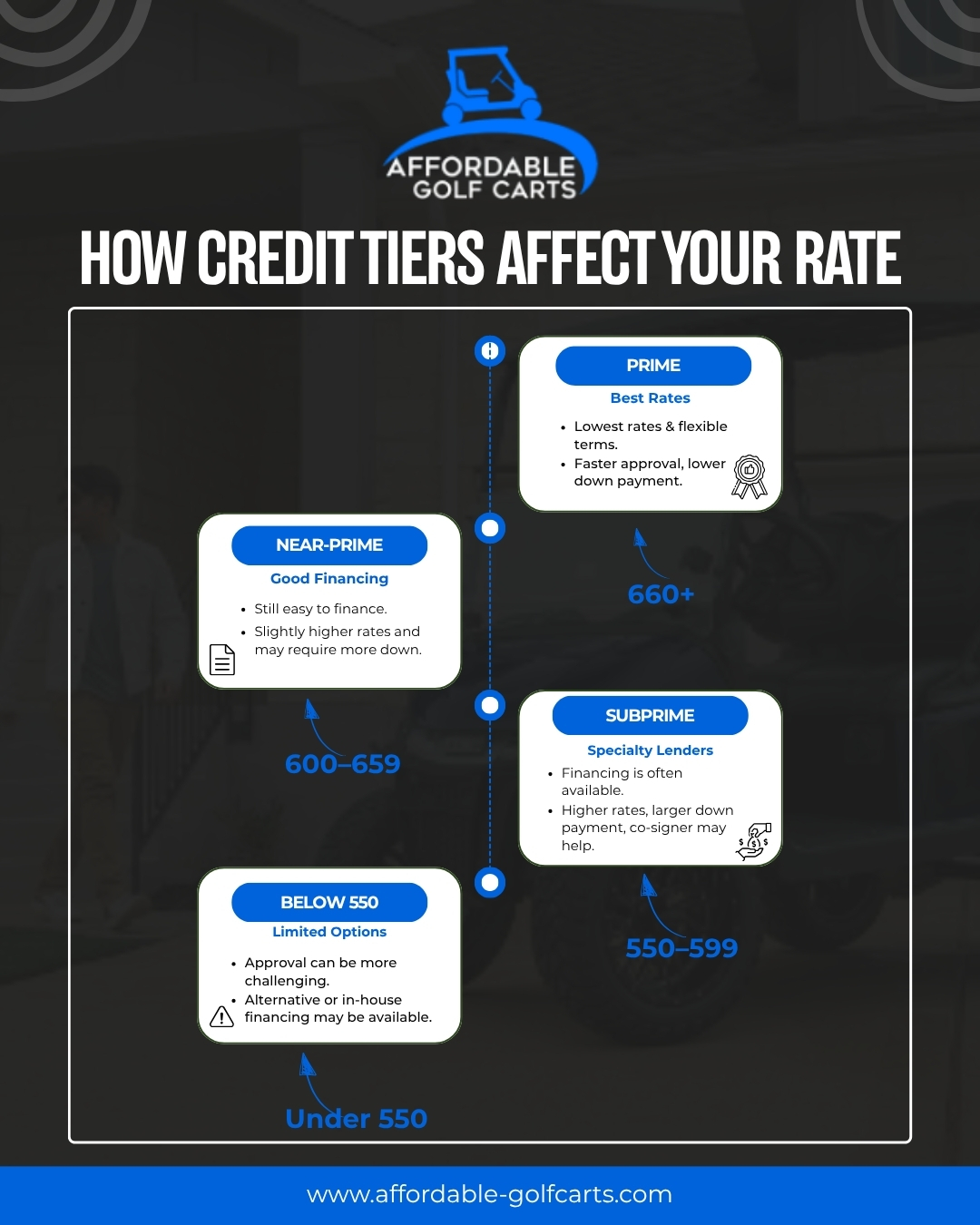
Lenders sort applicants into credit tiers, and the tier decides your rate far more than anything else. There is no single cutoff across every lender, but the general Florida powersports market sorts out like this.
- Prime, roughly 660 and above: the best rates and the widest choice of terms. Prequalification is usually quick, and down payment requirements are lighter.
- Near-prime, roughly 600 to 659: still very financeable. Expect a somewhat higher rate and possibly a request for more money down.
- Subprime, roughly 550 to 599: financing is often still available through specialty lenders, but the rate is higher, and a larger down payment is common. This is where a co-signer can genuinely change your offer.
- Below 550: harder, and this is where in-house or alternative arrangements sometimes come into play if a lender declines.
Two practitioner notes for budget buyers. First, the soft prequalification pull means you can find out your tier without dinging your score, so there is no reason to guess. Second, we do not make guaranteed-approval claims, and you should walk away from anyone who does, because approval always depends on the lender reading your actual file. Nobody can promise the answer in advance. What we can do is help you present the strongest version of that file.
New Versus Used Golf Cart Financing In Florida
New and used carts do not finance the same way, and for a budget buyer, the difference is worth understanding before you fall for a specific cart.
A new cart is easier to finance on paper. Lenders like a fresh unit with a clear value and a manufacturer’s warranty behind it, so terms can stretch longer and rates can run a little lower. The catch is that the higher price means a bigger loan, so even at a better rate, the monthly payment can land above a used car.
A used cart is where most of our budget buyers end up, and it finances fine, just with a few wrinkles. Lenders may cap the term based on the cart’s age, so a ten-year-old cart might only qualify for a shorter loan. The amount financed is smaller, which usually means a lower payment even if the rate is a touch higher. The thing that trips people up is battery condition, because a pack nearing the end of its life is a real near-term cost the loan does not cover. We flag battery age on every used electric cart we sell for exactly that reason, since a $1,500 pack replacement six months after purchase changes the math on a “cheap” cart in a hurry.
Something else worth knowing about used financing in Florida, specifically, the humidity and year-round use here are hard on batteries and connectors, so a used cart’s real condition can differ a lot from its age on paper. A five-year-old cart that lived under cover and got charged properly can outlast a three-year-old cart that sat in the sun. Lenders price the loan off age and value, not off how the previous owner treated it, which is why a careful in-person look at the cart matters more than the odometer-equivalent hour meter alone.
If your goal is the lowest comfortable payment, a solid used cart with honest battery life is almost always the better budget play than stretching for new.
How Much Down Payment Do You Actually Need
Down payment is the lever budget buyers control the most, and it does more than lower your monthly number. A larger down payment shrinks the amount financed, can move a borderline application into approval, and signals to the lender that you are committed, which sometimes earns a better rate.
There is no universal minimum. Some prime buyers qualify for very little down. Near-prime and subprime buyers often see a request for 10% to 20% down, and putting an extra few hundred dollars in can be the difference between a decline and an approval when your credit is on the edge. On a budget cart, even $500 to $1,000 down meaningfully changes both your odds and your payment.
Our practical advice: bring what you comfortably can without draining the account you will need for insurance, registration if you are going street-legal, and the small maintenance costs every cart eventually has. A down payment that leaves you cash-poor on day one is not a win.
What A Dealer Needs To Run Your Application
You can shorten the whole process by showing up prepared. When you come in ready to apply for golf cart financing, having these in hand means we can prequalify you the same day instead of chasing paperwork.
- A valid government photo ID (Florida driver’s license or state ID).
- Proof of income, usually a recent pay stub or bank statements if you are self-employed.
- Proof of residence if your ID address is out of date, such as a utility bill.
- Your down payment method, whether that is a card, check, or cash.
- A rough idea of the monthly payment you are comfortable with, so we match the cart to the budget instead of the other way around.
If your credit sits in the near-prime or subprime range, a co-signer with stronger credit can widen your options, so it is worth deciding in advance whether someone is willing to sign with you. Nothing here is a promise of approval, but arriving with a complete file is the single biggest thing you control.
When a co-signer actually helps
A co-signer is not a magic approval button, but it can move a borderline application. If your score is in the 550 to 620 range and your income is steady, a co-signer with prime credit often lowers the rate you are offered or unlocks a term the lender would not give you alone. The co-signer is agreeing to pay if you do not, so this is a real favor, not a formality. We usually suggest it only when the numbers say it will change the outcome, and we can tell you that after the soft prequalification rather than making you guess. If your own file is already strong, skip it and keep things simple.
A quick word on the total cost, not just the payment
Budget shopping tends to focus entirely on the monthly number, and that is fair, but it helps to glance at the total once. Take the monthly payment, multiply it by the number of months, add your down payment, and that is what the cart really costs you, financed. Compare it to the cash price so the interest is not a surprise. Sometimes a slightly shorter term with a payment you can still handle saves a few hundred dollars overall, and on a budget, that is money that stays in your pocket for insurance, a charger, or the first round of maintenance.
Where to go from here
Financing a cart on a budget is mostly about matching an honest monthly payment to the right cart, then coming in with your paperwork ready so a lender can give you a real answer. Know your rough credit tier, decide what you can put down, and lean toward a well-kept used car if the lowest comfortable payment is the goal. When you are ready to see what you actually qualify for, the team at Affordable Golf Carts can prequalify you with a soft credit check and walk you through options across our Hudson and Pasco County inventory. Come see the carts in person, tell us your target payment, and we will find the honest fit.
