
Buying a used golf cart in Florida on a budget comes down to five checks done in the right order: battery age, corrosion, floor rot, the controller, and the tires. Our heat and Gulf humidity wear those parts out faster than the hours meter suggests, so a five-year-old cart here can be in the shape a ten-year-old cart would be up north. Get those five right, and you skip the two costs that wreck a cheap cart deal: a dead battery pack and hidden rust.
TL;DR
Before you buy a used golf cart in Florida, check five things in this order: battery age and cell condition, corrosion on the frame and terminals, the floorboard for soft or rotted spots, the controller and solenoid for clean operation, and the tires for dry-rot cracking. Florida heat and Gulf humidity age a cart faster than the odometer or hours reading suggests, so a five-year-old cart here can be in the shape a ten-year-old cart would be up north. Ask the seller for the battery install date and a title, then test drive it up a small hill and check that it holds a charge. Do that, and you avoid the two biggest budget-killers: a dead battery pack and hidden rust.
What A Budget Buyer Needs To Check First
Most used golf cart guides were written for buyers anywhere. Florida is not anywhere. The heat, the afternoon storms, and the salt in the air off the Gulf change what wears out and how fast, and they change what a fair price looks like. This checklist is built around what we actually see roll into our Hudson lot every week, the parts that fail first here in Pasco County, and the honest price bands for a budget cart that still has good years left in it. You will get the inspection order that matters, the questions that flush out a bad seller, and what to feel for on the test drive.
Battery Age Is The Number That Decides The Deal
On an electric cart, the battery pack is the single most expensive thing that can go wrong, and in Florida it wears out sooner than the seller thinks. Lead-acid golf cart batteries that might last four to six years in a mild climate commonly run closer to three here, because sustained summer heat speeds up water loss and internal corrosion inside the cells. That is not a small detail. A fresh 48-volt lead-acid set can run several hundred to over a thousand dollars installed, so a cart with tired batteries is not the bargain the sticker suggests.
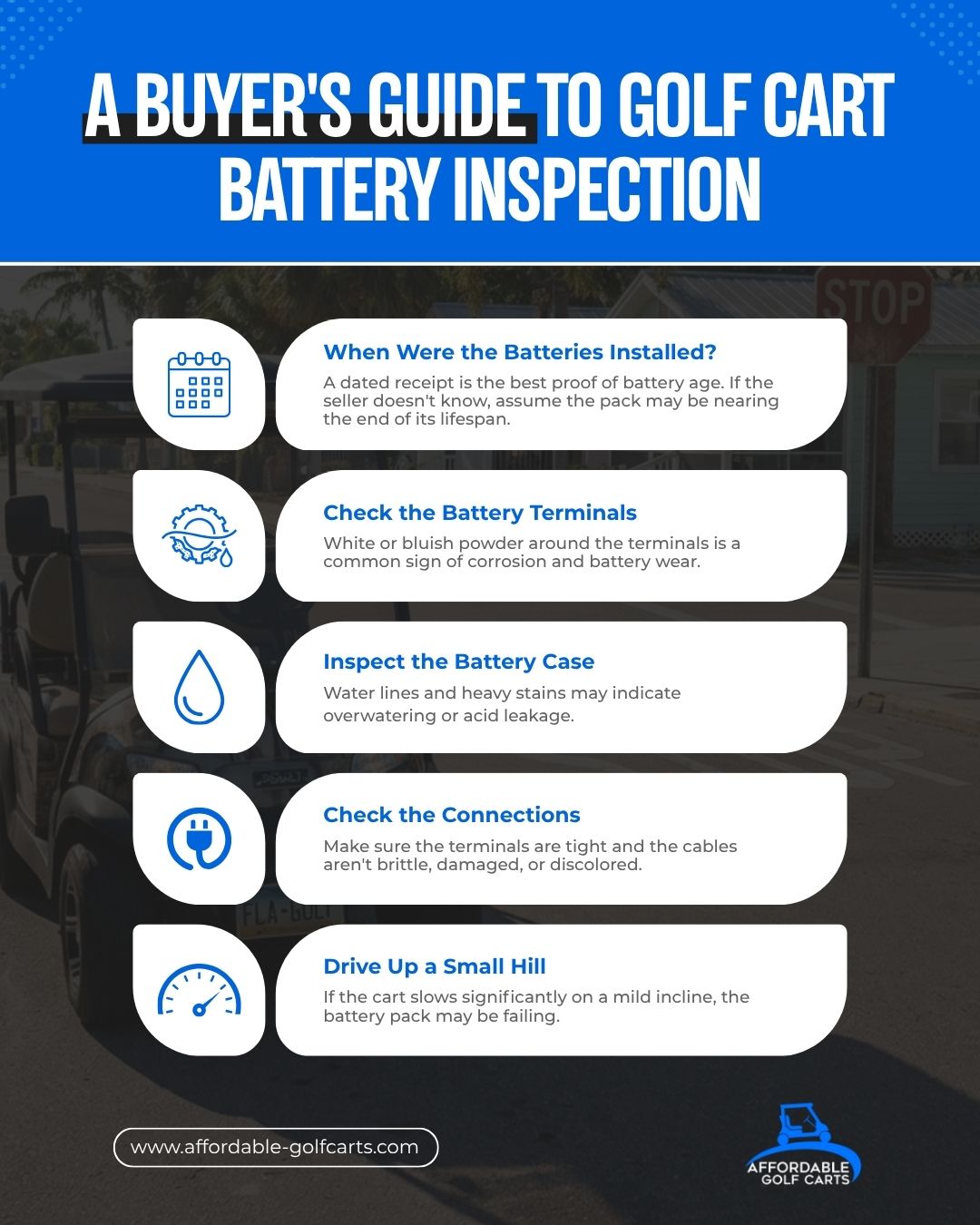
Ask one question before anything else: when were these batteries installed? A seller who cares will know, and a dated receipt is the gold standard. If nobody can tell you, treat the pack as if it is near the end and price the deal to match.
Then look and test:
- Lift the seat and check the tops of the batteries for white or bluish powder around the terminals. That crust is corrosion, and in our humidity it comes back fast even after a cleaning.
- Look for a water line or heavy staining down the sides of the cells, a sign of chronic overwatering or acid leakage.
- Feel that terminals are tight and cables are not brittle or green underneath.
- On the test drive, run it up any small incline. A pack that sags hard or the cart that slows to a crawl on a mild grade is telling you the batteries are done.
If it is a lithium cart, the math changes. Lithium packs tolerate Florida heat far better and usually outlast lead-acid by years, but they cost more used, so confirm you are actually paying for a healthy lithium pack and not a lead-acid cart dressed up in the listing.
Corrosion Is The Florida Tax On A Used Golf Cart
Corrosion is the damage that separates a Florida cart from a northern one, and it is the thing budget buyers miss most. Salt air off the Gulf and daily humidity get into every bare metal fastener, connector, and frame joint. A cart that lived near the water and got hosed down but never dried properly can look clean on top and be rusting underneath.
Here is the practitioner detail we would not skip: get low and look at the frame rails and the steel around the rear axle and the brake backing plates behind the rear wheels. Surface rust is normal and fine. Flaking, scaling metal that leaves orange on your hand, or a frame that has been freshly spray-painted to hide something, is a walk-away or a hard price cut. Also pull apart one or two electrical connectors if the seller allows it. Green or chalky copper inside a connector means moisture has been getting in, and intermittent electrical gremlins in a humid-climate cart almost always trace back to corroded connections, not the expensive controller itself.
Aluminum-framed carts, like many Club Car models, resist frame rust better in coastal air, which is worth knowing when you compare two similar carts at the same price. One more thing we watch for on Pasco and coastal Hernando carts: check the battery tray and the metal under the seat, not just the frame rails. That tray sits right under the batteries, catches any acid mist and rainwater, and is often the first steel to rot through even when the rest of the frame still looks solid. A rusted-out tray is a repair most private sellers never mention.
Floor Rot And Body Damage You Can Feel With Your Hands
Golf cart floors take a beating in Florida. Wet feet, rain that blows in, and carts left uncovered through storm season all soak the floorboard over time. On older carts with wood or composite floor structure, that moisture leads to soft spots and rot you can feel by pressing firmly with your thumb or stepping down in different spots.
Walk the floor corner to corner. Anything spongy, flexing, or cracked around the pedals is a repair, not a cosmetic flaw. Check the seat base and any storage compartment for standing-water stains and mildew smell too. A musty cart usually means it sat wet, and where there is trapped moisture, there is often corrosion and floor damage nearby. None of this is automatically a deal-breaker on a budget cart, but every soft floor and mildew smell is a bargaining chip.
Storm season is the hidden factor here. A cart that rode out hurricane season after hurricane season under a tarp, or worse in a spot that floods, will show it in the floor and the wiring even if the body shines. If a cart was ever partly submerged in a flood, walk away regardless of price, because water that reaches the controller and battery connections leaves damage you cannot fully see and cannot cheaply fix. Ask directly whether it was ever caught in high water, and trust a soft floor over a confident answer.
Controller, Solenoid, And The Drive System Test
The controller and solenoid are the brain and the main switch of an electric cart, and replacing them is not cheap, so you want to confirm they work cleanly before you buy rather than guess. You do not need a meter for a basic check. You need your ears and a short drive.
- Turn the key and press the pedal gently. A single clean click from the solenoid is normal. Rapid clicking, chattering, or a long delay points to a weak solenoid or, again, corroded connections in our climate.
- Accelerate smoothly from a stop. Jerky, surging, or hesitant power delivery can mean a failing controller or a worn accelerator sensor.
- Listen for grinding or whining from the rear end that changes with speed, which points to the motor or differential.
- On a gas cart, check that it starts without excessive smoke, idles steadily, and does not leak oil where it was parked.
Any of these can be fixed, but they are money, so factor real repair cost into what you offer.
Tires, Brakes, And The Safety Basics
Tires tell a story. In Florida sun, tires dry-rot and crack on the sidewalls long before the tread wears out, especially on a cart that was stored outside. Look for cracking in the rubber, uneven wear that hints at a bent frame or a steering problem, and check that all four hold air. A matched, non-cracked set is worth paying a little more for.
Brakes are non-negotiable. Press the pedal and confirm the cart stops straight and firm without pulling to one side or making a grinding noise. Rusty, scaling brake hardware behind the rear wheels is common here, so include a look at the backing plates when you check corrosion. Confirm the headlights, taillights, turn signals, and horn all work if the cart is set up as a street-legal LSV, since those are required for legal road use and expensive to sort out later.
Fair Used Price Bands For A Florida Cart
Honest numbers matter more than a sales pitch, so here are realistic ranges for used carts in the Florida market as of 2026. Treat these as ballpark bands, not fixed prices, because condition, brand, battery age, and whether it is gas, lead-acid electric, or lithium all move the number.
| Cart profile | Typical used range | What drives the price |
| Older gas or lead-acid, 10-plus years, runs | $2,500 to $4,000 | Age, tired batteries, cosmetic wear |
| Mid-age electric, roughly 5 to 8 years, good batteries | $4,500 to $7,000 | Battery health, brand, street-legal features |
| Newer or lithium-converted, low use | $7,000 and up | Lithium pack, newer body, warranty remaining |
| Fresh 48V lead-acid battery set (if you replace) | Several hundred to $1,200-plus installed | Number of batteries, brand, installation labor |
For a budget buyer, the sweet spot is a mid-age cart with batteries under two years old, because you skip the biggest surprise cost. A cheaper cart with an unknown battery age can end up costing more once you add a new pack.
If you would rather skip the guesswork, browsing a lot of reconditioned used golf carts for sale that have already been checked over is the shortcut, and it is why many local buyers start there instead of chasing private listings. If the sticker is still a stretch, spreading it out with easy golf cart financing often costs less per month than replacing a surprise battery pack on a cheaper cart.
The Test Drive And Seller Questions That Flush Out A Bad Cart
A good test drive is more than a lap around the driveway. Drive it long enough for a weak battery pack to show itself, take it up any small grade, brake hard once from a safe speed, and cut the wheel both directions to feel the steering. A cart that feels strong and cold but fades after a few minutes has a battery or heat problem worth knowing about before you pay.
Ask the seller plainly:
- When were the batteries installed, and do you have the receipt?
- Do you have a clear title or bill of sale?
- Has it been stored inside or outside, and was it ever near salt water?
- What has been repaired, and is anything not working right now?
A seller who answers straight and lets you look closely is usually selling a cart they took care of. Someone who rushes you, blocks a real test drive, or cannot answer the battery question is telling you something. When you shop our own used golf carts for sale in Hudson, those answers come standard, and we are happy to have you press on the floorboard and run it up the hill yourself.
Where to go from here
Buying a used cart in Florida comes down to reading the things heat and humidity attack first: the battery pack, the corrosion, the floor, and the drive system, then matching what you pay to what you find. Run this checklist on any cart before you hand over money, and you will filter out the expensive surprises fast. If you would rather start with carts that have already passed an inspection like this, come see the reconditioned inventory at Affordable Golf Carts on State Road 52 in Hudson. We keep gas and electric options in stock; we finance, and we will walk the checklist with you, cart by cart.
