
Two sets of rules decide whether your cart is allowed on the streets where you live. Florida statute is the floor, and it is short: speed caps, a small equipment list, daylight hours, and an ID rule. Your community sits on top of that with its own registration, decals, insurance proof, and road map, and it is the layer that actually stops people at the gate.
TL;DR
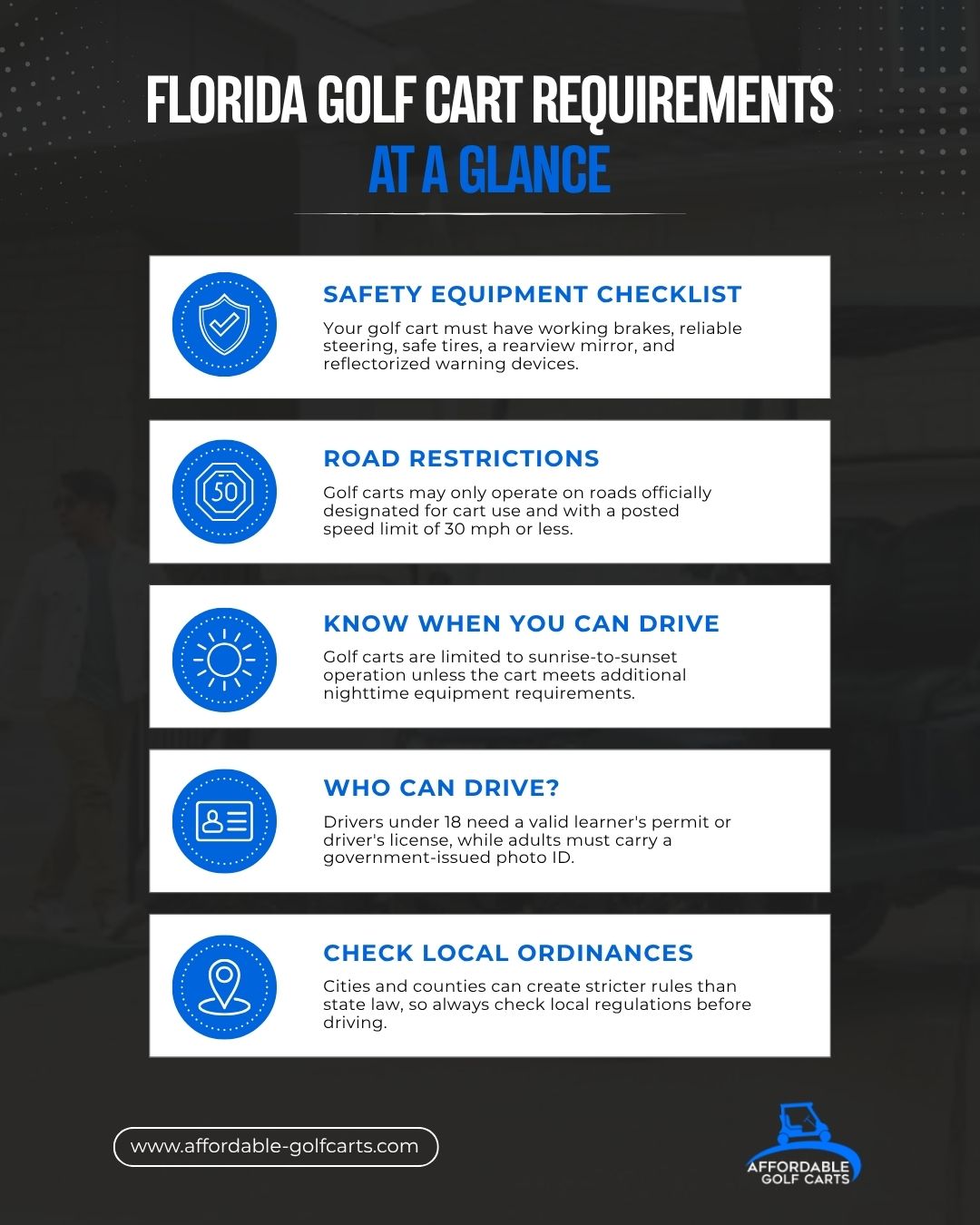
Florida law lets a golf cart run on roads posted at 30 mph or less, during daylight, with brakes, steering, safe tires, a rearview mirror, and red reflectors front and rear. Drivers under 18 need a learner’s permit or license, and drivers 18 and over need government photo ID.
A 55-plus community can require more, and most do. Sun City Center bans night driving outright and allows only three State Road 674 crossings. Solivita requires every privately owned cart to be registered with a decal on the windshield.
Before buying, get your community’s own cart document in writing, because that document, not the statute, is what gets checked.
What Does Florida Law Actually Require Before You Drive?
A golf cart on a Florida public road needs working brakes, reliable steering, safe tires, a rearview mirror, and red reflectorized warning devices on the front and the rear. It may only run on roads a county or municipality has designated for cart use, and only where the posted limit is 30 mph or under. Those requirements are in Florida Statute 316.212, which also limits operation to the hours between sunrise and sunset unless the local government has approved after-dark use and the cart carries headlights, brake lights, turn signals, and a windshield.
The driver rule changed in 2023 and still trips people up. Under the same statute, anyone under 18 must hold a valid learner’s driver license or driver license, and anyone 18 or older must carry a valid form of government-issued photographic identification while driving the cart. There is no separate cart license and no plate.
One more line in the 2025 edition of the same statute matters more than any of the equipment text. Local governments may pass ordinances on cart operation and equipment that are more restrictive than the statute, and they have to post signs or otherwise tell residents the ordinance exists. That single sentence is why two carts built to identical specs can be legal in one town and parked in the next.
Where the Community Bar Sits Above the Statute
Private roads inside a gated 55-plus community are not public roads, so the statute is not the document doing the work there. The association, the club, or the community development district writes its own rule, and it can ask for anything it wants short of something illegal.
In practice, we see four extra layers, in roughly this order of frequency.
| The extra layer | What it looks like in practice |
| Registration | Filed with the association, with a decal or sticker that stays on the windshield |
| Liability insurance | A certificate at the coverage amounts the community picks, not the state |
| Who may drive | A rule of its own, often tighter than the state’s age rule |
| Where you may drive | A map, formal or informal, of permitted internal roads, paths and crossings |
None of that shows up in a statute search. It shows up in a PDF on a community website, in a resident handbook, or in a form at the amenity office.
Sun City Center Publishes Its Rules, and They Are Stricter Than the State
Sun City Center in Hillsborough County is the clearest published example in our delivery area, because its cart rules are written down in one place. The Greater Sun City Center Golf Cart Drivers Handbook is named the official reference manual by the Hillsborough County Sheriff’s Office, the Sun City Center Community Association, the Federation of Kings Point Condominiums, Freedom Plaza, and the Villages of Cypress Creek. It is not a marketing page. It is the document a deputy and a resident are both working from.
Four rules in it are stricter or more specific than anything in state law.
Every street inside Sun City Center is approved for golf carts, which sounds permissive until you read the next part. Carts are not allowed on the main roads west of South Bay Hospital, because the posted limits there run above 30 mph, though the cart paths alongside those roads stay open. The same handbook allows State Road 674 to be crossed at three locations only:
- Kings Boulevard and Valley Forge Drive
- Trinity Lakes Drive and Sun City Center Plaza
- Pebble Beach Boulevard
Turning onto SR 674, in either direction, is prohibited under any circumstances.
Night driving is banned. Not discouraged, banned, lights or no lights.
The insurance section is the one we point buyers at most often, because it corrects a belief almost everyone arrives with. The handbook quotes a homeowner’s policy that covers a cart only “when using for golfing purposes”, and states plainly that shopping trips, doctor’s appointments, and banking runs need a separate golf cart policy. It puts the approximate cost of that separate coverage at $1.00 per week and directs residents to the Community Association’s Consumer Affairs Office for local providers, again in the same handbook. Treat that figure as the committee’s own published estimate and get a current quote, but the point stands: your homeowner’s policy is probably not covering the trip to Publix.
The stale page nobody warns you about
Here is the part worth knowing before you rely on any community handbook, including a good one. The Sun City Center handbook carries a revision date of August 2009, and it summarizes what it calls “the 2008 state law”. Its driver section says a golf cart may not be operated on public roads by anyone under the age of 14.
That age line is no longer what the state requires. Florida replaced it, and 316.212 now sets the bar at a learner’s permit or driver’s license for under-18 drivers and photo ID for everyone else.
The community rules in that handbook still stand, because a community may be stricter. The state-law summary inside it is fifteen years old. When a community document and the current statute disagree, the safe reading is whichever is tighter, and the statute is not optional.
The handbook also notes an annual golf cart safety inspection run with the Sheriff’s Office, usually held in March at the Prince of Peace Catholic Church parking lot on Valley Forge. If you are buying a cart in the fall for a Sun City Center address, that inspection is the deadline worth putting on the calendar.
What Solivita Asks For Before a Cart Is Authorized
Solivita, the 55-plus community in Poinciana on the Polk County side, runs a registration system for privately owned carts rather than an open-door policy. Its published golf information states that all personal golf carts must be registered and that a registration decal must be displayed on the golf cart windshield at all times.
For course access, the bar is higher again. A signed trail fee agreement plus proof of golf cart insurance is required, and the Solivita HOA golf page says trail fee members pick up their windshield decals at the pro shop once that proof of insurance is shown, with starters checking for the decals. Insurance is not a suggestion there. It is the thing that produces the sticker, and the sticker is what says your cart belongs.
Buyers who come to us searching for affordable Solivita golf carts are usually trying to work out one thing: whether the cart they are looking at will clear community registration on day one or need work first. That is answerable before you buy, and it costs nothing to ask.
Lake Ashton and the Districts That Publish Their Forms
Some communities make this easy because they are legally required to. A community development district is a unit of local government in Florida, so its rules and forms are public records posted on a district website.
Lake Ashton, the 55-plus community straddling the Winter Haven and Lake Wales line, is one of these. The Lake Ashton II Community Development District document library, at lakeashton2cdd.org, carries a golf cart registration document alongside the district’s rules chapters and the golf club rules. If you live in a CDD community anywhere in Polk, that library is where to look first, before you call anyone.
Where a community has not published its cart rules online, the requirement varies, and nobody outside the office can tell you what it is. Do not guess from what a neighbor did three years ago.
The Paperwork and Equipment Checklist We Build To
This table is the working version of everything above. The left column is the state floor for a golf cart on a public road. The right column is what communities in Pasco, Polk, Hernando, and Hillsborough commonly stack on top.
| Item | Florida statute floor | What a 55-plus community often adds |
| Brakes, steering, tires | Required | Annual community safety inspection |
| Rearview mirror | Required | Some ask for side mirrors as well |
| Red reflectors front and rear | Required | Reflective tape or a slow-moving emblem |
| Lights and windshield | Only for approved after-dark use | Required regardless, or night use banned outright |
| Driver age | Learner’s permit or license under 18, photo ID at 18+ | Licensed drivers only, sometimes 18 or 21 minimum |
| Insurance | Not required for a golf cart | Certificate of liability filed with the association |
| Registration | None with the state | Association registration plus a windshield decal |
| Where you may drive | Designated roads, 30 mph or less | A specific internal street and crossing map |
| Hours | Sunrise to sunset | Daylight only, enforced by the community |
Two rows in that table cause almost every problem we see. Insurance, because the state does not require it for a golf cart and the community does. And registration, because a cart bought in July does not become community-legal until somebody files a form.
The equipment column is the easy part. Mirrors, reflectors, lights, and a windshield are bolt-on work, and a cart missing them is not a bad cart. The paperwork column is the one with a queue in front of it.
Do You Need a Golf Cart or a Titled LSV?
If any part of your regular route runs on a road posted above 30 mph, you need a low-speed vehicle, not a golf cart. An LSV is a four-wheeled vehicle with a top speed above 20 mph but no more than 25 mph, and under Florida Statute 316.2122, it may run on roads posted at 35 mph or less. The driver must hold a valid driver’s license. The vehicle must be titled, registered, and insured, and it must carry headlamps, stop lamps, turn signals, taillamps, reflex reflectors, parking brakes, rearview mirrors, a windshield, seat belts, and a VIN.
Registering an LSV pulls in the same financial responsibility rules as a car. Florida Statute 324.022 requires the owner of a registered motor vehicle to maintain the ability to respond in damages of $10,000 for property damage in any one crash, which is the floor your insurer will quote against. That is a real annual cost, and it is the honest reason we ask about your route before we show you anything.
Inside a gated community with 25 mph streets, plenty of residents never need the LSV build at all. The moment your regular trip crosses or runs along a 35 mph connector, the calculation flips. Our new cart inventory and our used inventory both carry carts on either side of that line, and tell us the road is faster than guessing at the spec sheet.
How to Pull Your Own Community’s Cart Document
Four places, in this order, and it rarely takes more than an afternoon.
- The community website: Look for a document library, resident forms, or rules and regulations, and ask for the file by name: “golf cart registration form” and “golf cart rules”.
- The district site, if you live in a CDD: It is separate from the social or amenity site, and it is the one holding the public records.
- The amenity or management office: Two questions only: what do you require on the cart, and what do you require on paper. Get the answer emailed, because the person at the gate works from the written version.
- The county or city: Cart access to any public road outside your gate depends on that road having been designated for carts, and on whether your county or municipality has passed a stricter ordinance of its own.
If you rent or are buying resale, read the governing documents you were given at closing as well. Cart rules are frequently buried in an amenity policy rather than the main declaration, which is why so many owners believe their community has no cart rule at all.
August in Pasco and Polk Changes the Timeline
Right now is the slow part of the year for cart shopping in Hudson, and the busy part of the year for community offices, which is a useful combination. Boards meet through the summer, seasonal residents return to Polk and Hernando communities from October onward, and registration desks get long lines in November when everyone unpacks a cart at once.
Heat matters too. A cart sitting in a Pasco driveway through August is a cart with a battery pack under stress, which is worth reading up on if you are weighing packs in our lithium versus lead acid comparison. Buying in August and registering in September beats both queues.
Pull Your Community’s Cart Rules Before You Shop
The order that works: find out what your community requires on paper, find out which streets you are actually allowed on, then pick the cart. Doing it the other way round is how people end up with a beautiful cart and a registration form they cannot complete.
If your community wants lights, mirrors, seat belts, or a windshield your cart doesn’t have, that is shop work, and we handle it before delivery rather than after; our service department sorts equipment gaps in one pass. Tell us your community and street, and we will tell you honestly which carts on our lot clear it. Browse what Affordable Golf Carts has ready now, or come see us in Hudson.
